Core Thesis
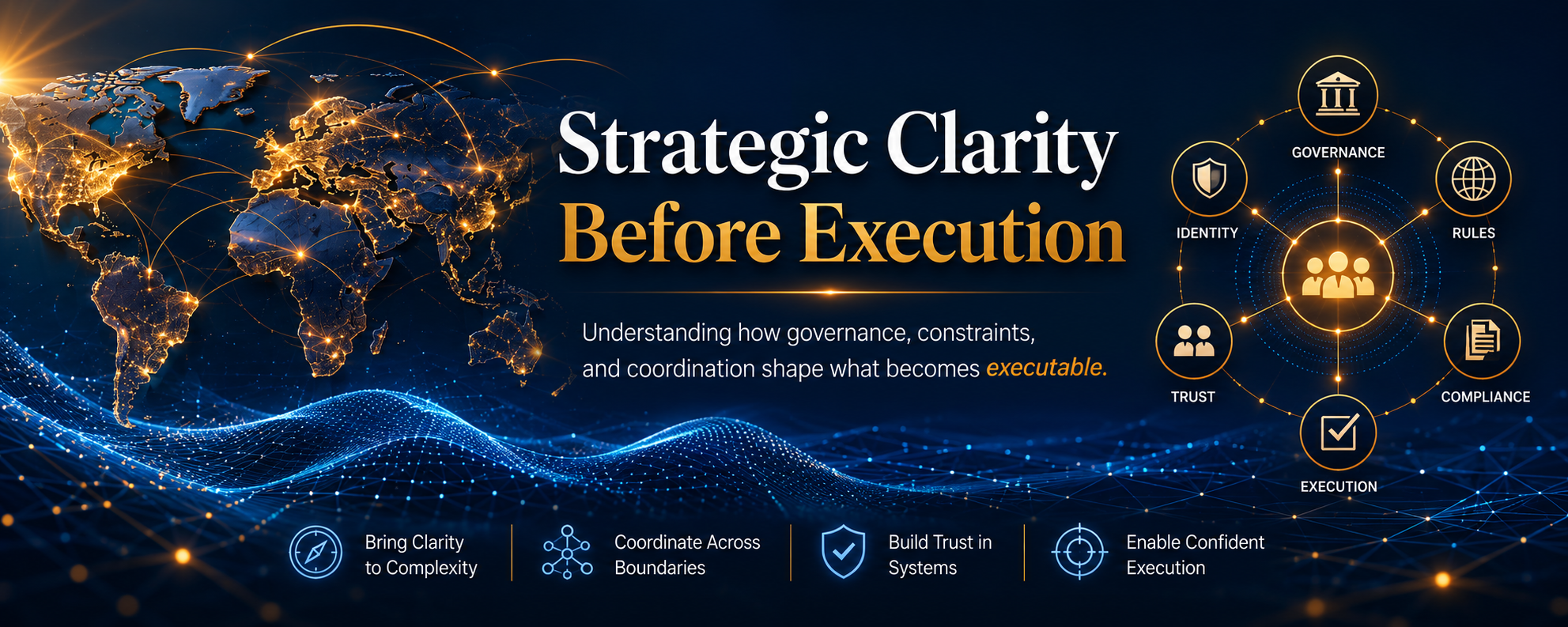
Governance precedes interpretation
Objectives and authority establish the boundaries within which interpretation operates.
Integration preserves coherence
Integration is not successful because information moved. It is successful because shared meaning survived.
Execution is the consequence, not the objective
Deterministic execution emerges only after governance, interpretation, and integration achieve coherence.
Why This Matters
Institutions have largely solved how to exchange data.
The remaining challenge is preserving shared meaning across independently goverened systems.
As AI, digital assets, and real-time infrastructure converge, integration becomes less about connectivity and more about maintaining coherent interpretation before execution.
This paper argues that integration is the architectural process through which independent systems preserve shared interpretability while remaining independently governed.
Research Highlights
- Defines integration as the preservation of shared interpretability.
- Distinguishes connectivity from coherence.
- Extends the Governance and Interpretation frameworks.
- Introduces recursive institutional integration.
- Explores implications for AI-enabled financial infrastructure.
Research Context
The Integration Layer extends the institutional architecture developed throughout Anderson One Research: Volume I. Building on the Coordination, Governance, and Interpretation layers, it examines how independently governed systems preserve shared interpretability while coordinating across institutional boundaries.
- Structural Digitization of Capital Markets — Introduced the transition toward programmable financial infrastructure.
- The Coordination Layer — Examined how independent systems coordinate action.
- The Governance Layer — Defined how objectives and authority establish permissible boundaries.
- The Interpretation Layer — Positioned AI as the institutional interpretation layer preceding deterministic execution.
- The Integration Layer — Examines how independently governed systems preserve shared interpretability across institutional boundaries.
- The Coherence Layer (Coming August 23, 2026) — Completes the architectural framework by identifying coherence as the property that preserves structural validity across the entire system.
Anderson One Strategic Group
Anderson One Strategic Group conducts independent research on institutional coordination, digital financial infrastructure, AI governance, and emerging market architecture. Our work is intended to support strategic decision-making across financial institutions, technology providers, regulators, and infrastructure organizations.
For institutions navigating the transition toward programmable, constraint-aware financial systems, begin with structured clarity—not assumption.


.PNG)